A Brief History About Belgian Disc Golf
The evolution of disc golf in Belgium from the 1980s to today. Key moments, pioneers, and courses that shaped Belgian disc golf.
"If I could choose one place to play disc golf forever, that would be Belgium."
Early beginnings
Disc golf in Belgium started in the mid-1980s, mainly around Namur, in Wallonia. This Namur community became the main hub of Belgian disc golf for many years, organizing tournaments and maintaining the country’s earliest course.
Genesis
Local players began experimenting with the sport around Namur.
First competitions
The first tournaments took place through a Belgian Tour, later evolving into a Benelux Tour with events in neighboring countries.
First permanent course and tournament
With a 9-hole layout, Parc d’Amée in Jambes becomes the first of many to come.
The Amée Open becomes the first PDGA sanctioned tournament in Belgium, a part of the EuroTour.
Early competitions and international exposure
During the late 1990s and early 2000s, Belgium began hosting more structured events. From 1999 onwards, Belgian organizers started running 2–3 disc golf tournaments per year, including events such as the Easter Open. In 2007, the Belgian Tour is born.
European Championship
Belgium hosted an event with 17 nations and around 240 players, marking the largest international disc golf competition in the country up to that point.
Belgian Tour
The National Tour is born. A series of competitions that continue to this day.
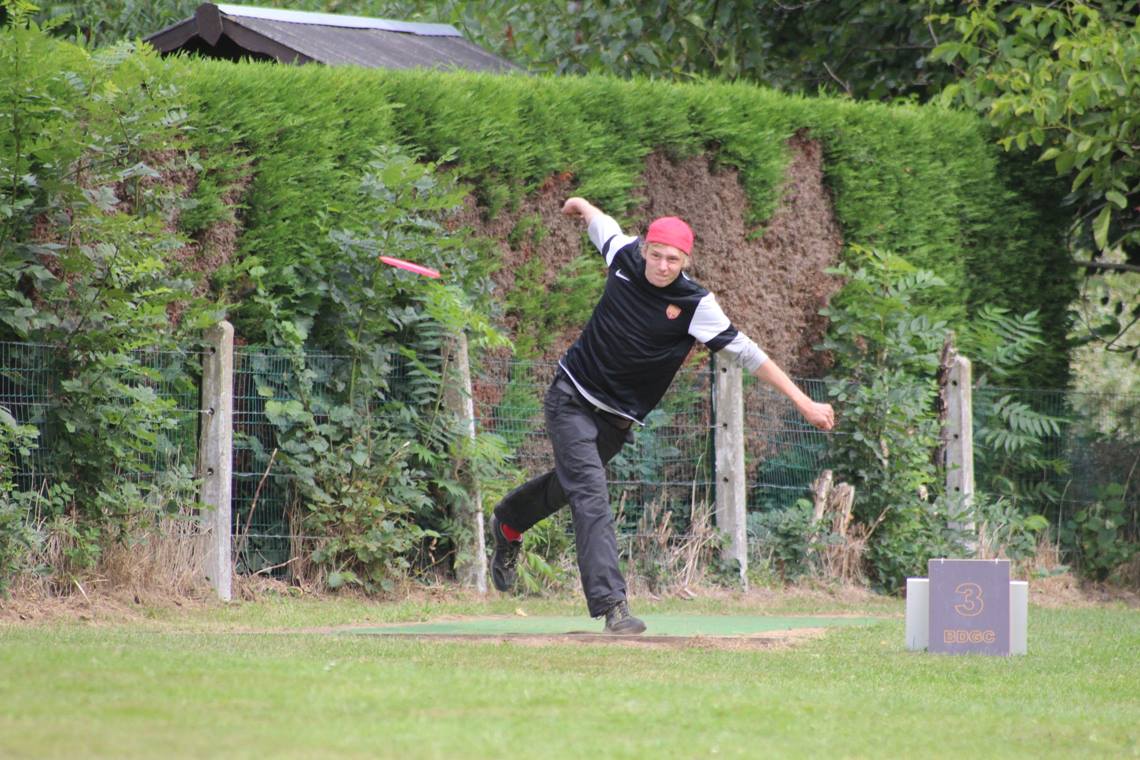 The one and only Simon Lizotte thrashing the Parc Bourdon course at the 2013 Belgian Open.
Growth and Professionalization of Belgian Disc Golf
For many years, disc golf in Belgium developed slowly, with only a small number of permanent courses and a limited but dedicated player base. Most activity was concentrated around a few key locations that hosted early tournaments and community events. Among the most important early courses were Parc d’Amée, the country’s historic first course, as well as Parc Bourdon, Louvain‑la‑Neuve Disc Golf Course and Yvoir Disc Golf Course. These courses served as the backbone of the Belgian scene throughout the 2000s and early 2010s, hosting many of the country’s first leagues and tournaments. During this period, the community remained relatively small but stable, and a Belgian National Tour gradually emerged as the country’s main domestic tournament series.
From the late 2010s onward, the sport began expanding more rapidly. New clubs appeared across the country, particularly in Flanders where disc golf had previously been less developed. One example is Disc Golf Club Zuidrand, founded in 2022, reflecting the growth of new communities and organized play. Additional courses were also installed, including Putte Heerkenshoeve Disc Golf Course, which opened in 2021. This period saw a noticeable increase in grassroots clubs, more frequent tournaments, and growing media attention around the sport.
In the 2020s, Belgium also began hosting higher-level professional competitions, marking an important step in the country’s integration into the international disc golf scene. One of the most prominent events is the Belgian Open, traditionally played at Parc Bourdon. In the early 2020s the tournament joined the European Pro Tour, and in 2024 it became part of the Disc Golf Pro Tour Europe as a Silver-level event. This milestone attracted more than 100 international players and a prize purse exceeding €20,000, representing a significant step toward the professionalization and international recognition of Belgian disc golf.
Belgian Disc Golf Today
Today, disc golf in Belgium is experiencing one of the most active and dynamic periods in its history. The sport is supported by a growing network of clubs across both Flanders and Wallonia, with local communities organizing leagues, tournaments, and outreach activities throughout the year. Belgian clubs are the strong grassroots foundation of the sport, with active volunteer communities maintaining courses, developing new layouts, and introducing new players to disc golf.
At the competitive level, Belgium now has a well-established national circuit through the Belgian National Tour. The tour has grown steadily in recent years and is set to reach a record 11 events in the 2026 season, reflecting both the increasing number of courses and the strong demand for competitive play across the country.
Alongside the national tour, several tournaments have become modern Belgian disc golf classics. Among them are the internationally recognized Green Man Challenge and the Zuidrand Zandbergen Challenge, which attract players from Belgium and neighboring countries. Belgium is also part of the 4 Nations Cup, an international series connecting tournaments in Belgium, Germany, France and Luxembourg, helping strengthen regional competition and collaboration between the disc golf communities of these countries.
Another key event in the Belgian calendar is the Belgian Open, historically one of the country’s most prominent international tournaments. After a short hiatus, the event is scheduled to return in 2026, further reinforcing Belgium’s presence on the European disc golf stage.
Belgian players are also increasingly visible in international competition. National teams regularly participate in European championships and other international events, while many individual players travel across Europe (and occasionally around the world) to compete in tournaments on the professional and amateur circuits. This growing international presence reflects the continued development of the Belgian scene and the rising level of competition among its players.